
Picture an owner looking for a way to judge what their marketing is doing. They might start with one question: how do I measure an agency's performance? Then they ask which indicators suit their business, what separates engagement from sales, and what they need to know before deciding.
If your site offers them nothing but phrases like integrated solutions and exceptional results, they will struggle to find an answer they can use. The problem starts with the content, before it ever reaches keywords.
Features such as AI Overviews and AI Mode have made the way information surfaces in Google a live question for site owners. Google's own guidance carries a point worth reading twice: the best practices for SEO remain relevant, and there are no additional requirements to appear in AI Overviews or AI Mode, nor other special optimizations necessary.
What has to change in your content
Our reading at Yalla Sales Pro is that it starts with the questions customers actually ask.
Instead of a broad article called the importance of digital marketing, answer something specific: when does your company need to rebuild its website before spending more on ads?
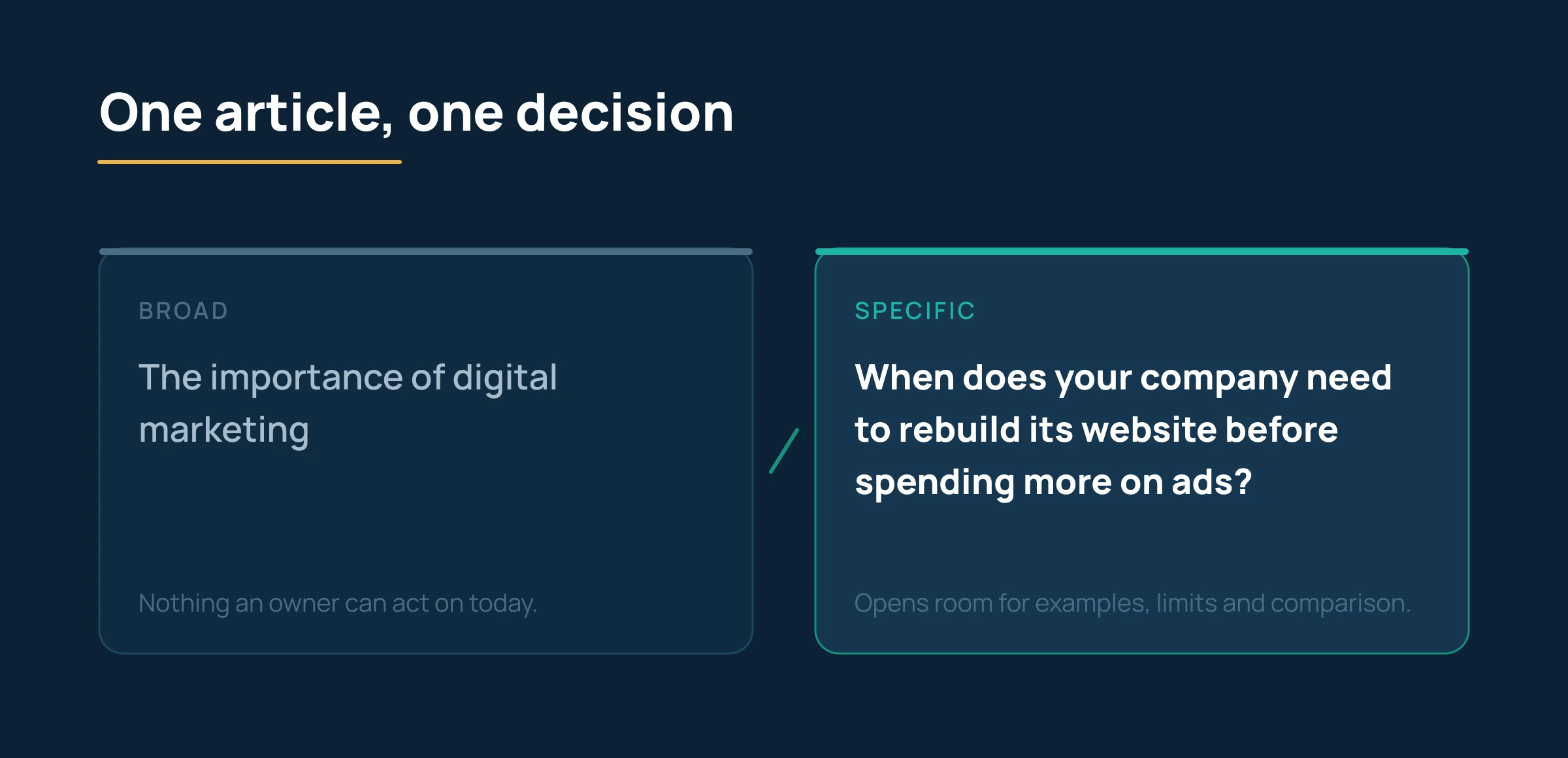
The second question opens room for explanation, examples and comparison. It hands the decision maker something they can use, even if they do not buy from you today.
That is the job we want company content to do: show the quality of the thinking behind the service.
Build every article around one decision
An article about choosing a marketing agency can help a reader judge a proposal. What are the deliverables? Who owns the accounts? How are results measured? And what does the price include?
An article about raising sales can separate weak reach from a weak offer from follow-up that stalls. Gathering all three under one piece of advice, run more ads, leads an owner to spend money on something that was never the cause.
Useful content also says where an idea stops. If you use a hypothetical example, call it one. If you quote a number, give its source and its period. If the result changes by sector, say what changes it.
What about the technical side
Google states that to appear as a supporting link in its AI features, a page must be indexed and eligible to be shown in Search with a snippet. It points to internal links that make content findable, important content available as text, a good page experience, and structured data that matches the visible text. Meeting every requirement is still not a guarantee: Google says plainly that indexing and serving isn't guaranteed.
In practice, sit with whoever runs the site and check that pages can be indexed, that headings are clear, that the text is comfortable on a phone, and that articles link to the services they relate to.
If a visitor reads an article about measuring marketing, let it lead somewhere sensible, to an explanation of the analysis work, rather than a sales link pushed into every paragraph.
Two articles a week, and making the count serve the purpose
We suggest one of the two starts from a documented report or piece of news and explains what it changes about a commercial decision. The other answers a practical question owners keep asking.
Each one gets a main question, a primary search term, examples that fit, and one internal link that helps. An article does not need to gather economy, currencies, sales and artificial intelligence into a single piece to be strong.
After publishing, watch which queries the article appears for and how many clicks it earns in Search Console, then look at what readers do once they are on the site. Use what you learn to choose the next topics. Do not expect one week to prove an SEO strategy right or wrong.
At Yalla Sales Pro we want a website to help a customer reach a clearer decision. When content gives an answer worth reading, it starts building the trust that marketing and sales both depend on.
Write the article you wish you had read before an important decision in your own company.