
The owner of a small business in the Gulf is running a different company today from the one they ran before 28 February 2026, even if they have changed nothing. The price of a container changed. Insurance terms changed. The customer's mood changed. So did the price of the fuel moving the delivery vans.
In the first two days of the Hormuz crisis more than 5,400 flights were cancelled across seven Gulf airports, Jebel Ali port stopped and restarted, the UAE stock markets halted for two days, and Kuwait froze food prices at pre-crisis levels (Al Jazeera, 2 March 2026). Seven months on it has not settled: in the first week of October at least 12 tankers were involved in security incidents near the strait, the highest in a single week since the crisis began, according to Reuters (Al Jazeera, 11 October 2026).
This article is not about politics and does not predict tomorrow. It is three things: the real numbers that raised the cost of every small business in the region, three lessons from the companies that did not close, and a simple tool that measures where your own business stands in 15 minutes.
What actually happened: the numbers that raised your costs
The problem was never the oil price. It was three lines that feed straight into the cost of any business importing or selling in the Gulf: freight, insurance and demand. These figures come from official releases and established papers, not estimates.
| Item | Before 28 February 2026 | After the crisis | Source |
|---|---|---|---|
| CMA CGM container surcharge | None | $2,000 for a 20ft container, $3,000 for a 40ft, $4,000 for a reefer. Charged even on bookings not yet shipped | The National, 2 March 2026 |
| Hapag-Lloyd container surcharge | None | $1,500 for a standard container, $3,500 for a reefer | The National, 2 March 2026 |
| Shipping a 40ft container, Shanghai to Jebel Ali | $1,800 on 1 March | More than $4,000 on 3 March | FreightWaves, March 2026 |
| War risk insurance on a vessel transiting Hormuz | About 0.001% of the vessel's value | About 4% of its value for a seven-day policy (June 2026) | The National, 3 June 2026 |
| Insurance cover for vessels in Gulf waters | Available | Major insurers suspended it from 5 March 2026 | Al Jazeera, citing Reuters, 2 March 2026 |
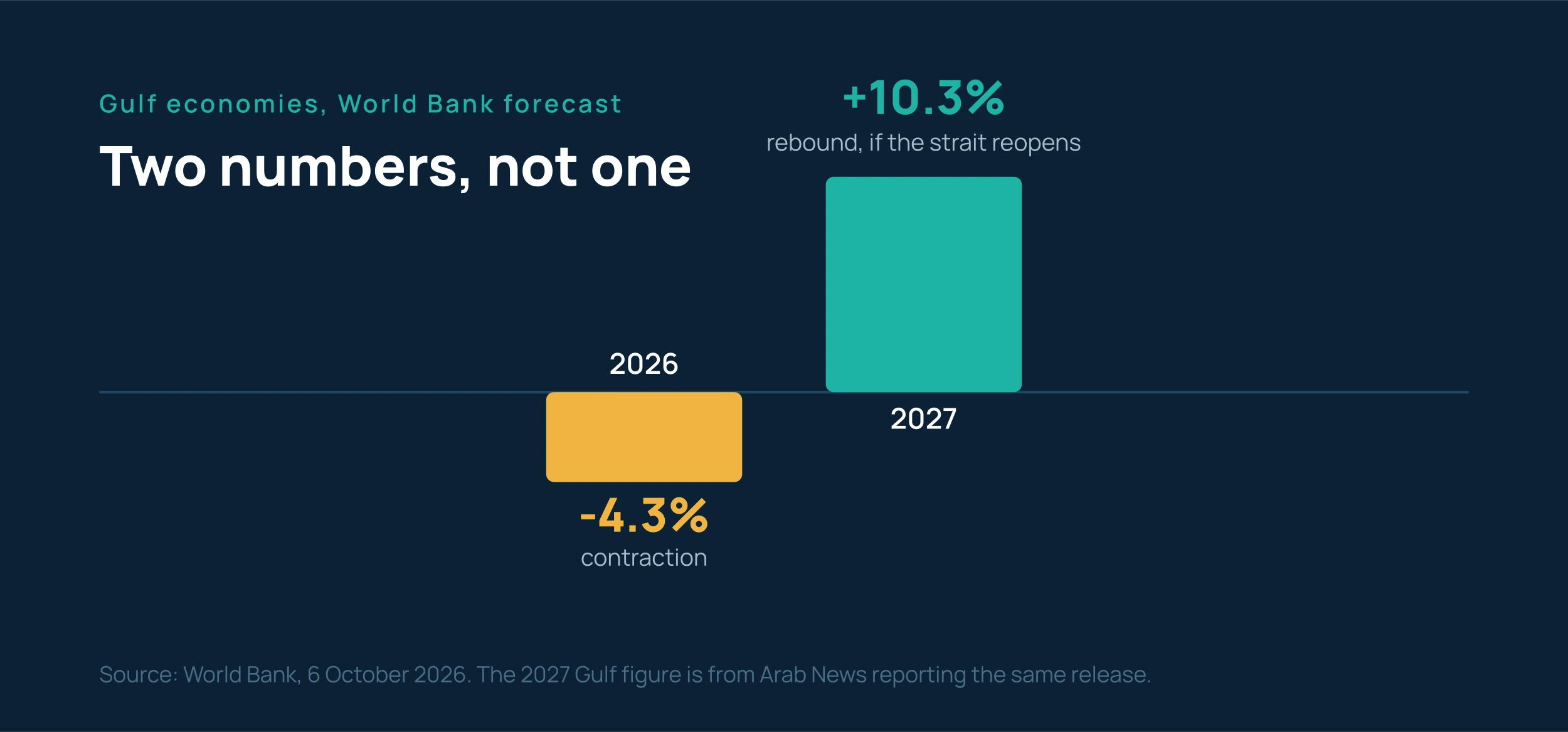
| Gulf economic growth in 2026 (World Bank) | Growth of about 4.5% expected | A contraction of 4.3% on average, Saudi Arabia at -2%, Oman the only one still growing at 3.1% | World Bank, 6 October 2026 |
| Global business insolvencies 2026 (Allianz Trade) | +4% expected | +6%, meaning 7,000 additional companies because of the crisis, rising to +10% if Hormuz stays shut, with 2.2 million jobs at risk worldwide | Allianz Trade, 22 April 2026 |
| Security incidents involving tankers near Hormuz | Zero | At least 12 in a single week in early October, the highest since the crisis began | Al Jazeera, citing Reuters, 11 October 2026 |
How to read the table: the big shock was in March, but the cost never came back down. Freight and insurance settled at a level far above February, and October saw more incidents than July. An owner running their business on the assumption that things will go back to how they were is running a business that no longer exists.
The most important sentence in the Allianz Trade report is not the insolvency number. It is the description of the companies that will fail: thin margins, or an inability to raise prices, or heavy debt, or money locked up in stock and in what customers owe them. Those are four traits, not four sectors. The three lessons below deal with them one at a time.
Lesson one: do not forecast, prepare
The companies that held on did not know when the crisis would end, and still do not. What they did was stop asking what will happen and start asking what they would do in each case. The American investor Howard Marks, who founded Oaktree, wrote a well-known memo after the 2001 crisis titled you cannot predict, you can prepare. The idea is simple: forecasting the future is a bet, while preparing for more than one outcome is management.
The World Bank itself does not give one forecast but two: a contraction of 4.3% in 2026, then regional growth of 7.8% in 2027 if conditions calm by the end of the year, with press reports of the same release putting the Gulf figure at 10.3% (World Bank, 6 October 2026). Allianz Trade gives two as well: +6% insolvencies, or +10% if the closure drags on. Large institutions do not predict. They set out possibilities and plan for each. A small business can do the same thing on a single sheet of paper.
| Scenario | The signal you watch for | The decision you take now |
|---|---|---|
| Conditions calm by the end of 2026 | Container surcharges falling, insurance returning on normal terms, an official announcement that Hormuz is open | Rebuild stock gradually, make the hires you postponed, price competitively to win customers back before your competitors do |
| It stays as it is now | Intermittent incidents, surcharges steady at current levels, demand weaker than 2025 | Lock the new cost into your prices, shorten payment terms, postpone any expansion that needs a loan |
| It gets worse | A full closure of Hormuz, insurance cover withdrawn again, your large customers paying late | Run the cash plan: stop unpaid orders, cut non-essential spending, sell on prepayment or against guarantees |
The table takes an hour with your team. Its value is not in the accuracy of the scenarios. It is that the hard decision gets made while you are calm, rather than on the day a shipping line emails you a surcharge on a container that has not sailed yet.
Lesson two: cash before growth
In a crisis companies do not die because they are unprofitable. They die because the cash runs out before the customers pay. Two of the four traits Allianz Trade names are about cash directly: the thin margin, and money locked up in stock and receivables. The crisis hit both at once. Costs rose and ate the margin, and goods arrived late and trapped the cash.
One example is enough. CMA CGM applied its surcharge to every booking issued from 2 March that had not yet shipped, and Hapag-Lloyd applied it even to cargo already at sea (The National). So an importer who signed a fixed-price sales contract in February found themselves paying an extra $3,000 on every 40ft container that was never in their price. Those who could pass the increase to the customer came out whole. Those who could not paid it out of their profit. According to Gallop Shipping in Dubai, the surcharges alone added between $1,500 and $4,000 per container, and fuel added about $200 more (Gulf News).
The five steps that protect cash, in order of how fast they work:
- Work out how many months your business can live, as a number and not a feeling: cash available divided by monthly costs. Under three months means one late customer could stop the company.
- Collect faster before you cut spending: a deposit on every new order, a small discount for immediate payment, and stop supplying anyone who is late rather than carrying on in hope.
- Put a cost pass-through clause in every quotation: the price holds for 7 days, and freight, insurance and any surcharge are charged to the customer at cost. That clause is the difference between a company that lost its profit in March and one that did not.
- Turn stock into cash: discount the slow lines and keep the cash for what sells quickly. Every extra container in transit is a surcharge paid in advance.
- Postpone every cost that will not bring revenue within 90 days: expansion, fit-out, the hire that can wait. Not cancelled, postponed, until the signals of the first scenario appear.
The order is deliberate. Most owners start at step five because it is the easiest, but cutting costs does not fill the account as fast as collecting sooner and pricing properly.
Lesson three: write down what you will not do, whatever happens
The remaining two traits on the Allianz Trade list are heavy debt and an inability to raise prices. Neither appears during a crisis. Both are built beforehand, by small decisions that looked sensible at the time: a loan for fast expansion, a long payment window given to a large customer for fear of losing them, a single supplier because they were cheapest.
Nitin Nohria, the former dean of Harvard Business School, calls the answer strategic boundaries, and his condition is that they are written as will not: not what we want to do, but what we will never do even when it looks profitable. The reason is that enthusiasm for growth in good times is what makes a company fragile in hard ones (HBS Working Knowledge). Nohria adds a second rule: decide in advance whose interest comes first when interests conflict, because what you decide during a crisis is a reaction rather than a value.
Five boundaries that deal directly with the four traits Allianz Trade names, and that belong on an office wall:
- We will not drop below three months of operating cash, even if the alternative is turning down a deal.
- We will not sign a fixed-price sales contract for more than 30 days without a clause passing on freight and insurance costs.
- We will not buy more than 40% of our requirements from one supplier or through one route that passes through Hormuz.
- We will not buy a long-term asset with short-term borrowing.
- When cash is tight the order is: the team's wages, then small suppliers, then the bank, then the owner's drawings. And this order is told to the team before a crisis, not during one.
The numbers in that list are not law. They are a starting point you adjust to your sector. What does not change is the principle: a boundary that is not written down is not respected.
Your readiness index: twelve questions, fifteen minutes
Answer honestly and add up the points. The maximum is 24. The questions follow the same four traits: cash and receivables, profit and pricing, suppliers and debt, and preparedness.