
You can spend well on a good advertisement, show a customer a product they need, and win the argument about price. Then lose them at the last step: payment.
A page that does not behave on a phone. A delivery charge that appears late. An error message that leaves the customer unsure whether they have been charged. Details that look small from inside the company, and large to the person about to hand over their money.
Figures published by the Saudi Central Bank put that last step under a light. Electronic payments reached 85% of all individual retail payment transactions by the end of 2025, against 79% in 2024. The number of electronic transactions through the national payment systems rose from 12.6 billion to 14.6 billion. This is data for 2025, not a live count for 2026.
What the figures mean for an owner
Six percentage points, from 79% to 85%. The commercial value of the news is larger than the percentage: paying electronically is now an ordinary part of buying in the Saudi market.
One distinction matters here. The figure does not say that 85% of purchases happen in online stores. Electronic payments include transactions made inside physical shops.
Our reading at Yalla Sales Pro is that an owner needs to review the whole buying experience. How does the customer arrive? What do they understand? And what happens at the moment they decide to pay?
Before you raise the ad budget, try buying from your own company
Open the site on your phone the way a first-time customer does. Pick a product, find its final price, and try to complete the order.
Do you learn the delivery charge before the final page? Is the delivery date clear? Can you understand the returns policy without hunting for it? And if the order fails, is there an easy way to get help?
These questions are where marketing meets sales. The advertisement makes a promise. The buying experience tests whether you can keep it.
Businesses that sell by quotation need the same clarity: a specific amount, terms a reader can follow, and a next step the customer already knows.
Measure the problem instead of guessing at it
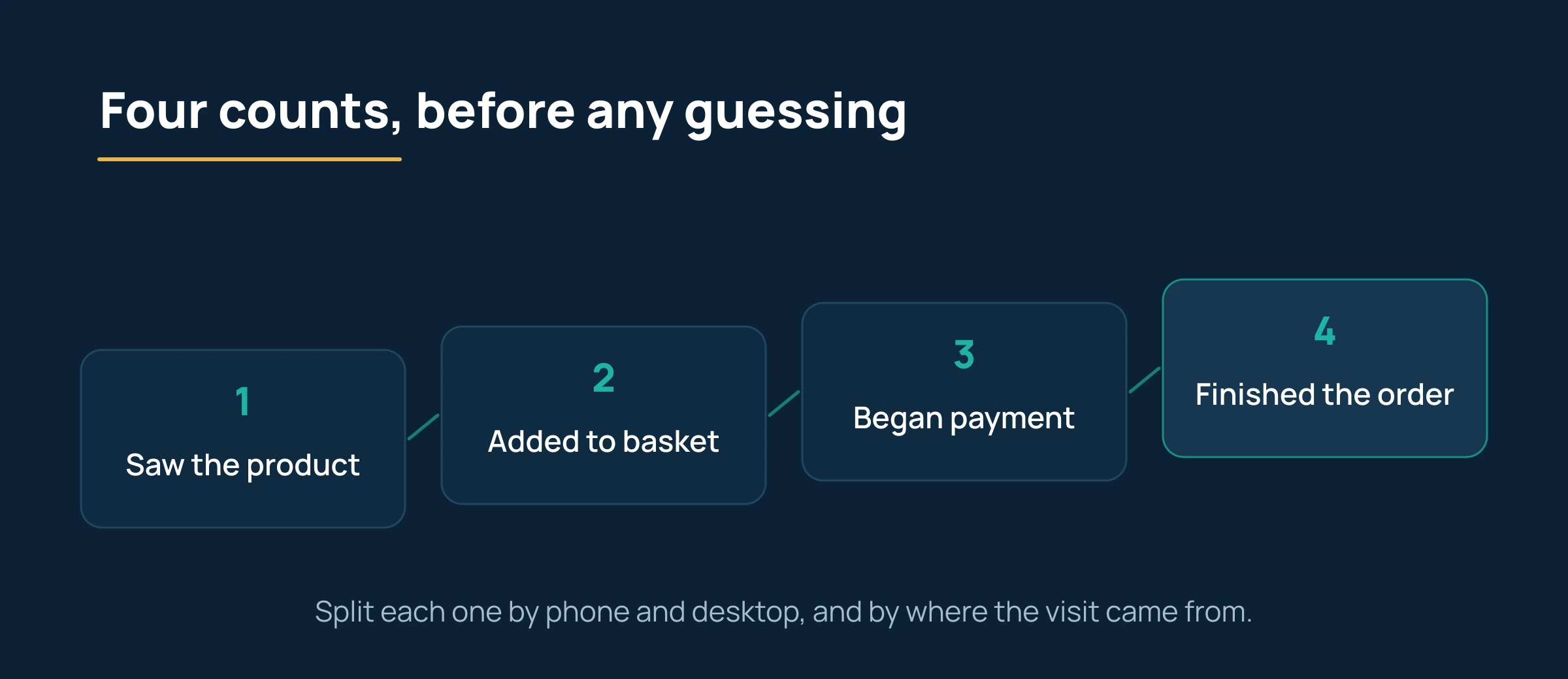
Start with four counts: how many people saw the product, how many added it to the basket, how many began payment, and how many finished the order.
An illustration, not a client result: if 100 people begin payment and 40 finish, completion among those who started is 40%. The number on its own does not tell you why the other 60 left. You may need to look at technical errors, at costs, at which payment methods you offer, and then ask a few customers what happened.
Split the results by phone and desktop, and by where the visit came from. The problem may sit in one page or with one audience rather than across the whole site.
One step for this week
Put the person who runs marketing, the person who runs sales and the person who runs the site in one room. Buy something from yourselves, and write down three moments that cause hesitation or confusion. Fix one of them, then compare results over a sensible period, allowing for campaigns and offers that changed in the meantime.
At Yalla Sales Pro we treat marketing as the start of a commercial experience. Winning attention matters. Holding the customer's trust to the end of the journey is what makes that attention worth paying for.
Before you ask how to bring more visitors, ask whether you have made buying clear and easy for the ones who already arrived.
Source
Saudi Central Bank, electronic payments in the retail sector. Figures describe 2025.