
White Friday is on 27 November. The question is not "should I join in?"
White Friday 2026 falls on Friday 27 November, and the big offers have already started. Amazon UAE is advertising discounts of up to 60% on selected products (and up to 40% on electronics and fashion) from 19 to 30 November, and a HarrisX study it commissioned says 85% of UAE shoppers are more likely to buy during sales this season (Gulf Business, 19 November 2026). The big brands are offering 50%, 60% and 70% off (Gulf News, 20 November 2026).
Faced with all that, a small business owner asks: should I take part? It is the wrong question. Shoppers are already inclined to buy during sale season. What is still open is who that spending goes to.
The right question: how do I sell on White Friday without losing my margin, when I have neither Amazon's margin nor Noon's war chest?
This article answers with three things: this year's numbers, which show Saudi Arabia and the UAE heading into November 2026 as two very different markets; a simple calculation that shows most small-business discounts lose money before they start; and a six-day plan to work through before Friday.
Two different markets this year: Saudi shoppers more confident, UAE shoppers more selective
The most important number this White Friday is not the size of the discount. It is the direction the shopper is moving in, and that direction is reversed between the Gulf's two largest markets. In its report "Consumer Behavior Amid Regional Uncertainty", published in July 2026, Deloitte surveyed 500 consumers in Saudi Arabia and 500 in the UAE about how their household spending had changed since the regional crisis began. On clothing, 39% of UAE respondents said their household had cut spending, while 40% in Saudi Arabia said theirs had increased it. On non-essential electronics, 37% in the UAE cut back and 39% in Saudi Arabia spent more. The report sums it up: Saudi consumers are net positive in every discretionary category, and UAE consumers are net negative in all of them (Deloitte, figure 5, p. 8).
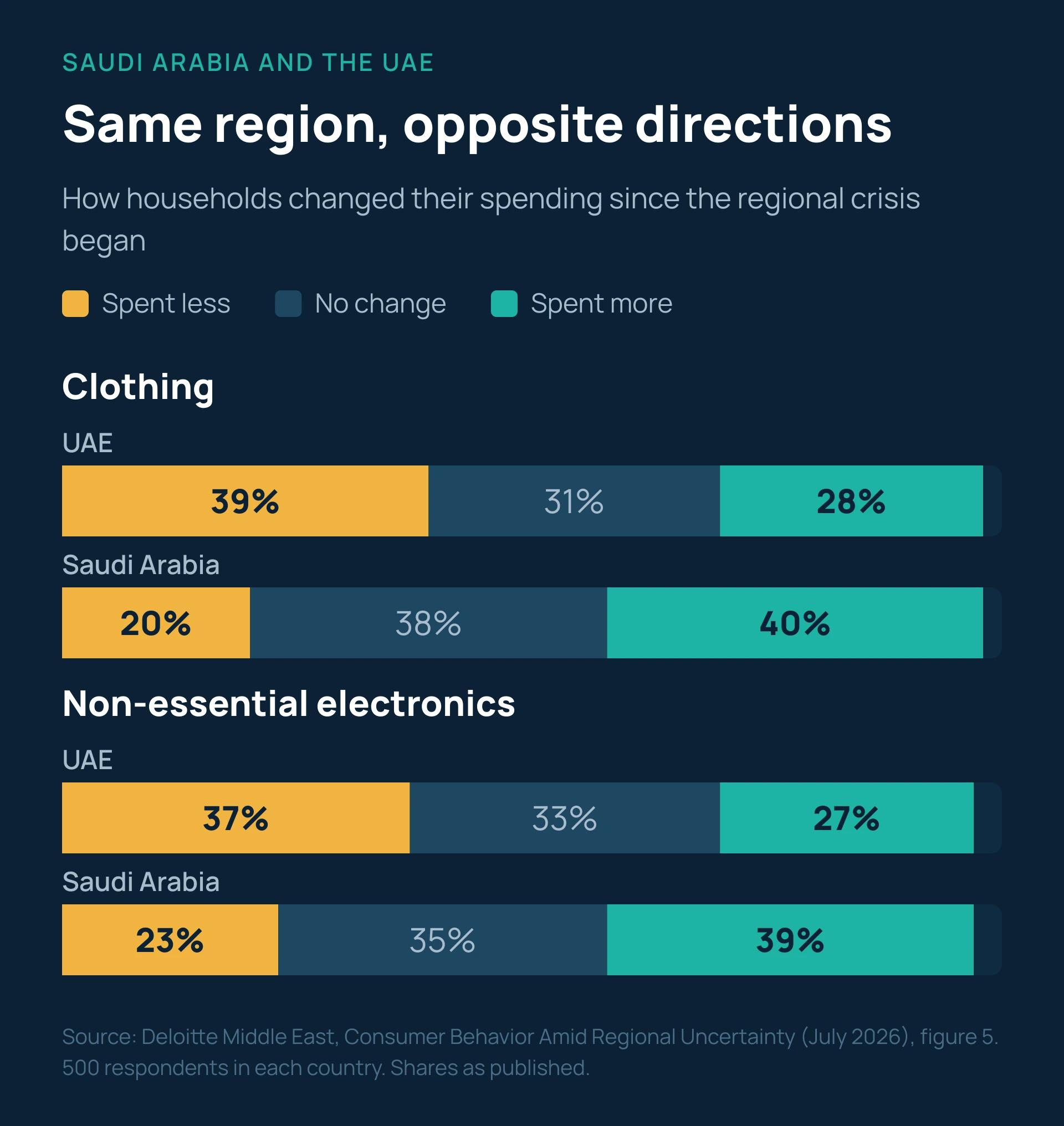
Even so, clothing and electronics were among the discretionary categories that fell least in the UAE, at net minus 11 and minus 10 percentage points. Deloitte's explanation is that residents are going out less and redirecting discretionary spending towards their homes and personal wellbeing. Trevor Jordaan of Blue Yonder cited the same figures this week (Gulf Tech News, 18 November 2026).
NielsenIQ's Consumer Outlook 2027, released on 27 October and based on more than 21,000 respondents in 31 countries, shows the same picture from another angle. 46% of Saudi respondents said they were better off than a year earlier, against 37% in the UAE, and 31% of UAE respondents said they were worse off, against 20% in Saudi Arabia. On behaviour, 43% of Saudi shoppers are buying more from discount stores against 39% in the UAE; 33% in the UAE have stopped buying certain products to focus on essentials, against 28% in Saudi Arabia; and 35% in the UAE use loyalty programmes to manage their spending, against 30% in Saudi Arabia (Communicate Online, 28 October 2026).
A caveat: NielsenIQ's behavioural figures relate mainly to fast-moving consumer goods, household and grocery shopping, not to clothing or electronics.
| Measure | Saudi Arabia | UAE |
|---|---|---|
| Household spending on clothing since the crisis began (Deloitte) | 40% increased | 39% cut |
| Household spending on non-essential electronics (Deloitte) | 39% increased | 37% cut |
| Better off than last year (NielsenIQ) | 46% | 37% |
| Worse off than last year (NielsenIQ) | 20% | 31% |
| Shopping more at discount stores (NielsenIQ) | 43% | 39% |
| Stopped buying some products to focus on essentials (NielsenIQ) | 28% | 33% |
| Using loyalty programmes to manage spending (NielsenIQ) | 30% | 35% |
What this means for your business
First, read it carefully. Jordaan himself points out that higher spending can mean consumers are paying more for the same quantity, so the Saudi figure does not necessarily prove stronger demand. He expects UAE shoppers to be more selective this White Friday, and Saudi Arabia to offer stronger opportunities in discretionary categories.
Second, Deloitte's recommendation, made about purchase plans for the year ahead: heavy promotional discounts are unlikely to be necessary, because demand remains intrinsically motivated. UAE consumers are cautious but not disengaged, so a message built on quality and value for money is more likely to work than one built on indulgence (Deloitte, p. 9). The UAE figures from Amazon's HarrisX study point the same way: 71% of shoppers plan their purchases in advance and 75% spend more time reading reviews and product details (Gulf Business, 19 November 2026).
In other words, a storewide discount gets lost. A focused discount on products the customer is already looking for is the one that feels like a saving worth having. Jordaan adds a warning: blanket discounts can lift sales without producing profitable growth, and promotions can pull forward purchases customers were planning to make in the following weeks. A business that cannot tell pulled-forward demand from new demand ends up with excess stock and more markdowns once the event is over.
The calculation nobody does before announcing a discount
A 20% discount does not mean you earn 20% less. It means you have to sell a lot more units just to get back to the profit you would have made without it. The formula is simple enough for a phone calculator:
Extra units needed = discount ÷ (gross margin − discount)
An example: your gross margin is 40% (a product you sell for 100 riyals costs you 60). A 20% discount leaves you 20 riyals of profit instead of 40, so you need to sell twice as many units (100% more) to make the same profit. The table shows the full picture:
| Gross margin | 10% off | 20% off | 30% off | 40% off |
|---|---|---|---|---|
| 30% | 50% more units | 200% more (3 times the volume) | Impossible: the discount equals the margin | A loss on every unit |
| 40% | 33% more | 100% more (twice the volume) | 300% more (4 times) | Impossible |
| 50% | 25% more | 67% more | 150% more | 400% more (5 times) |
| 60% | 20% more | 50% more | 100% more | 200% more |
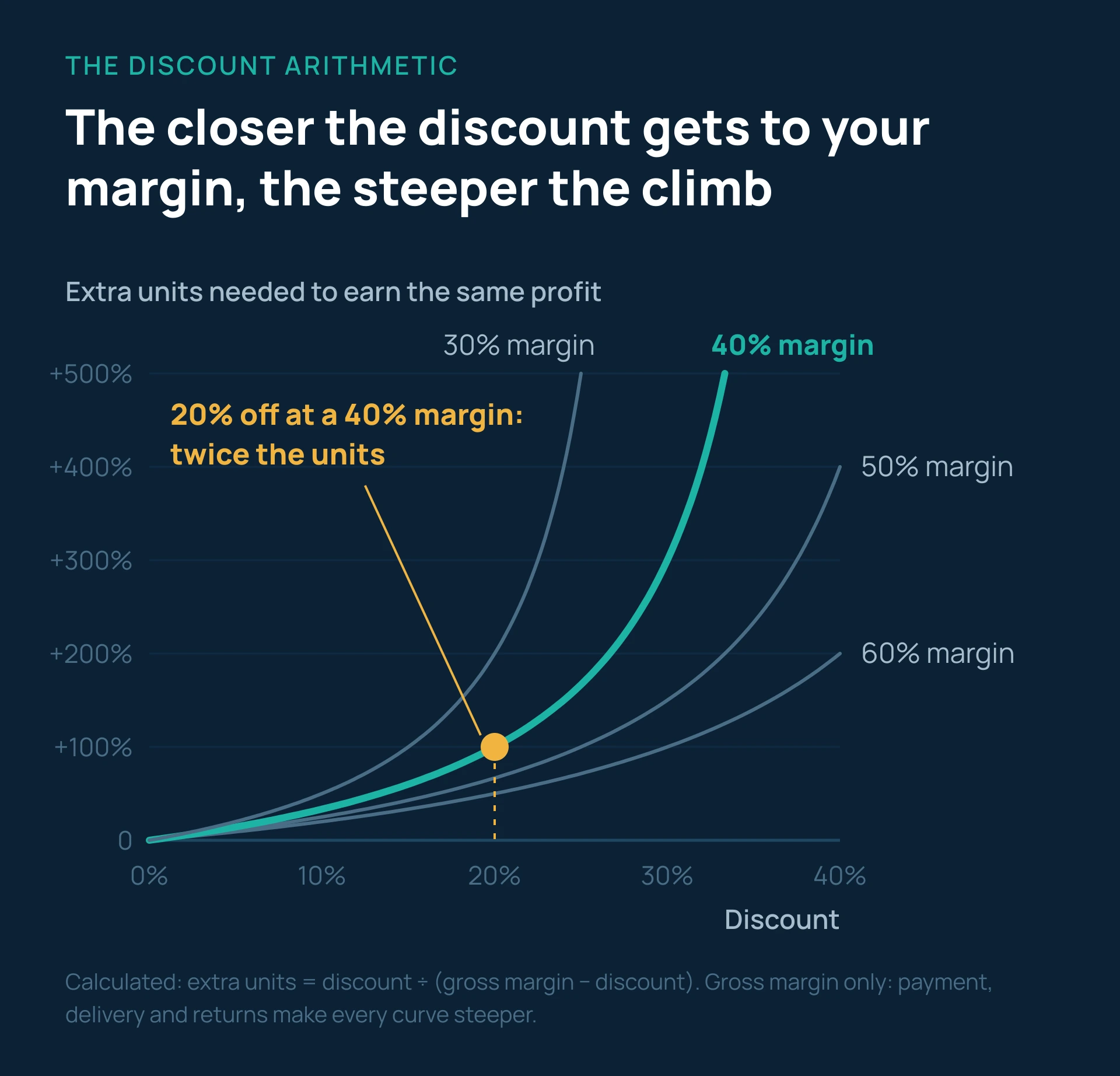
Three things make reality harder than the table:
- The table counts gross margin only. Payment gateway fees, delivery, packaging and returns are paid on every extra unit, so the real number is higher.
- Some of the "extra" units are not extra at all. They are purchases the customer would have made in the following weeks, as Jordaan warns. The discount went to someone who was going to buy anyway.
- Most small businesses do not know their gross margin accurately for each product. If you do not know the margin, you cannot know the safe discount.
The bottom line: a business with a 30% or 40% margin cannot announce "50% off" and make money, however much it sells. That is not pessimism, it is arithmetic, and it is why copying the big players is so hard: they make up for the discount with a sales volume you may not have. What you can do is sell differently, which is the next section.
Five ways to sell on White Friday without burning your margin
- Discount the slow sellers, not the best sellers. Put the deep discounts on products that have not moved in 90 days. That stock is capital tied up on a shelf, and selling it at a deep discount frees cash, as long as the discounted price stays above your cost. Your best sellers only need 10% to 15% off, because customers already want them.
- Sell a bundle instead of a percentage. "Main product + accessory + free delivery" at a price that looks like a big saving. The blended margin can beat a straight discount when the accessory carries a high margin and you would have paid for delivery either way. A bundle raises the order value instead of cutting the price.
- Tie the discount to the basket, not the product. "Spend 300 riyals and get an extra 10% off, spend 600 and get 20%." Brands in the UAE are doing exactly that this year: Under Armour adds an extra 15% on spends above AED 399 and 25% at AED 599, and HomeBox adds 10% on orders above AED 1,299 (Gulf News). A tiered discount works because it raises average order value, which is the number that actually pays for the discount.
- Give December instead of giving away November. Instead of 20% off in cash, give a voucher worth 20% of the order, redeemable from 5 to 31 December. The customer may see the same value, while you protect November's margin and give them a reason to come back in December. A voucher that is never used costs you nothing.
- Start with your customer list, not with ads. Paid advertising gets more expensive in White Friday week. According to Supermetrics, which analysed more than 5,000 retail advertisers on Meta in 2025, the cost per thousand impressions in Black Friday week was 16% to 41% higher than in September, depending on the sector. That data is not specific to the Gulf, and we do not have comparable Gulf figures (Supermetrics). A WhatsApp message or an email to your existing customers, with an early offer just for them, is a channel you own and do not pay to reach. It is stronger still because 35% of UAE shoppers and 30% of Saudi shoppers use loyalty programmes to manage household spending, according to NielsenIQ, so offer double points instead of an extra discount.
What the five have in common is that they answer the shopper's question the research points to, "is this a saving worth having, on something I want?", instead of the competitor's question, "how big is your discount?"
A six-day plan before Friday 27 November
| Day | Task | What you have by the end of the day |
|---|---|---|
| Saturday 21 November | Pull your product list and work out the gross margin on each product (selling price minus the cost of buying it and shipping it to your warehouse) | A two-column sheet: product and margin |
| Sunday 22 November | Sort products into three groups: best sellers, slow sellers (no movement in 90 days) and the rest. Set each group's discount from the table above, so the extra sales it requires are a number you can actually reach, and drop any product whose discount equals or exceeds its margin | The final offer list, with percentages |
| Monday 23 November | Build two bundles and one spend threshold (spend X, get Y), and set up the December voucher | Three offers ready to publish |
| Tuesday 24 November | Check stock and delivery: how many orders can you really ship per day? Set a daily order cap and do not promise what you cannot deliver | One number: daily delivery capacity |
| Wednesday 25 November | Send the early offer to your existing customers on WhatsApp and email, a day before everyone else | The season's first sales at zero marketing cost |
| Thursday 26 November | Publish the offers to the public, and write down a stop rule: if a product sells out or orders exceed delivery capacity, its offer stops immediately | Offers live on the site and social pages, with the stop rule posted where the team can see it |
The day after White Friday, before you celebrate the sales, work out just three numbers: actual gross profit after discounts and shipping (not revenue), the stock left from each offer, and average order value compared with October. Those three numbers tell you whether the season was a success or just busy.
What to do now, and what Yalla Sales Pro can do for you
Time is short, so we will not leave you to work the table out by hand:
- The safe discount calculator. Send us the words "White Friday" on Yalla Sales Pro's WhatsApp and within hours you will receive an Excel sheet. Enter each product's price, cost and proposed discount, and it tells you straight away how many extra units you need to make up for the discount, and marks in red every product that loses money before it starts. Free.
- A 20-minute session before Friday. We go through your final offer list with you and write up the bundle, the spend threshold and the December voucher, ready to publish. Free for the first 100 businesses that message us before Wednesday 25 November.
The businesses that come out of White Friday ahead are not the ones that sold the most. They are the ones that knew their margin before they announced their discount.
Sources
- Gulf Business, 19 November 2026 (Amazon UAE sale dates and offers, and the HarrisX study commissioned by Amazon): Amazon UAE White Friday Sale 2026 begins November 19
- tbreak, 19 November 2026 (HarrisX method: an online survey from 7 to 19 October 2026 that included 1,010 respondents in the UAE): Amazon White Friday sale, UAE
- Gulf News, last updated 20 November 2026 (offers from Under Armour, HomeBox, Giordano and others): White Friday 2026: Deals and discounts
- Deloitte Middle East, Consumer Behavior Amid Regional Uncertainty, July 2026 (500 respondents per country; figure 5 on p. 8, recommendations on p. 9): report page and PDF
- Gulf Tech News, 18 November 2026 (Trevor Jordaan of Blue Yonder on the Deloitte figures): White Friday 2026 in the UAE: How can retailers balance attractive offers with profitability?
- Communicate Online, 28 October 2026 (NielsenIQ Consumer Outlook 2027): Saudi, UAE shoppers shift spending toward value and premium products
- Supermetrics, Black Friday playbook for retailers 2026 (Meta cost per thousand impressions in Black Friday week 2025; data to 4 October 2026): Black Friday retail playbook
- The discount table and the discount curve: straight arithmetic from extra units needed = discount ÷ (gross margin − discount), with no outside source